Some criminals draw you in. He's done something terrible — violent, ugly, real harm — and yet something about him pulls your attention. Not into the darkness itself, but toward something underneath it. A light in his core, caked in filth, buried under everything he's done, but not extinguished. Just barely visible. When you sit with why, it stops being mysterious. That thing peeking through the filth is honesty.
Other criminals are just pathetic. There's nothing there to hold your attention, just a small, disordered person who lied his way into a life that's now a maze with no exit. That's what lying does over time. Every lie is another wall thrown up inside the maze, and after enough of them, even the liar can't find his own way back out. No light left to speak of. Just corridors.
The difference between these two men isn't what they did. It's whether they left a way back in. I want to walk through three examples that show this same quality wearing three very different faces — a violent defendant, a metal band, and a fictional villain — because once you see the pattern in one, you start seeing it everywhere.
The man who never flinched
Violent, by the cops' account. Violent again in how he carried himself in court. Most people in his position build a maze for the occasion — the remorseful face, the engineered story for the judge, wall after wall of managed appearance. He didn't bother. He accepted the punishment coming to him, then went a step further and told the court flatly: given the chance, he'd run, and he'd fight anyone in the way. No wall. The filth was real, but there was no maze hiding it either. Just the thing itself, visible, with light somewhere underneath still catching the eye.
If that were the only example, you could write it off as one strange man in one courtroom. But this isn't some private theory I stumbled onto. It's been sitting in front of us the whole time — in a chapel in Rome four hundred years ago, in music blaring out of car speakers, and in one of the most recognizable movies ever made. Once you know what to look for, you can't stop seeing it.
A Roman chapel, 1600
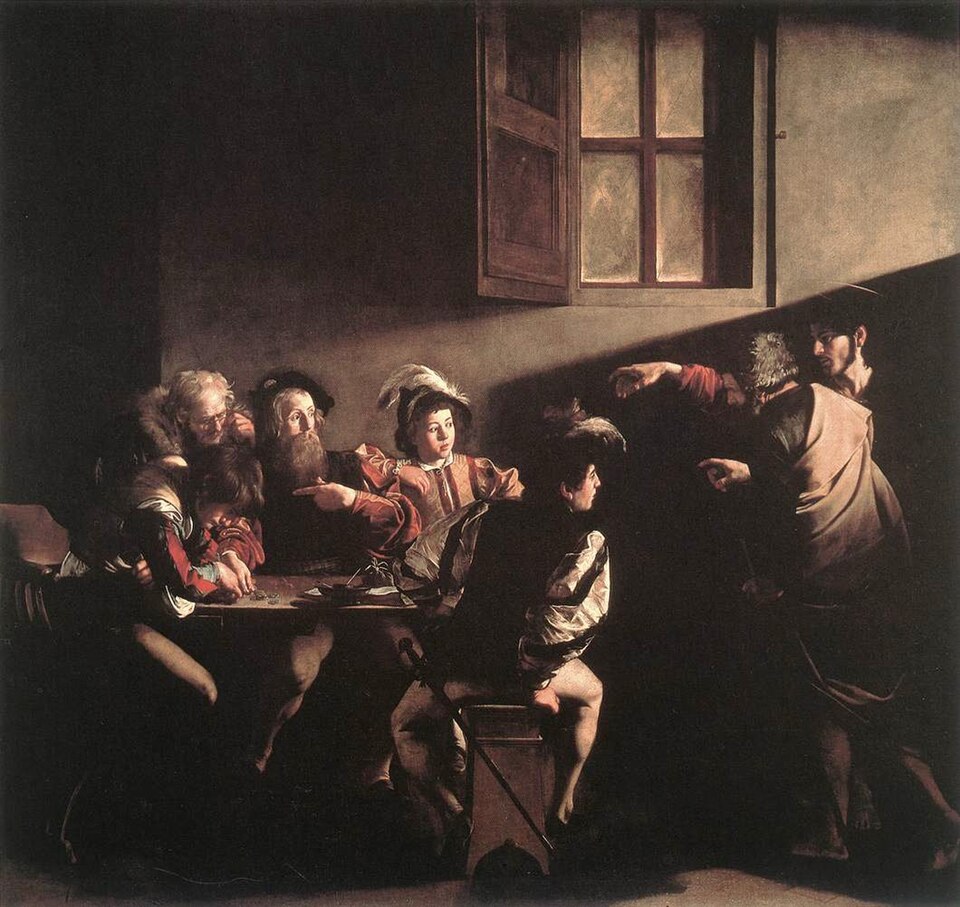
Matthew hasn't moved. He hasn't repented. He's still at the table with the coins. But the light has already found him — because there's nothing in him hidden from it. Two other men at the same table are so absorbed in counting money they never even notice Christ has entered the room. Matthew is no more virtuous than they are in that instant. He just isn't hiding from the light the way they are.
Modern music
Mudvayne is a heavy metal band known for wild, horror-inspired imagery — face paint, masks, an aesthetic built to unsettle — paired with a violent, yet oddly enthralling, sound. Wrong message, as far as I'm concerned. But there's no wall between what they claim to be and what they are. No focus-grouped image, nothing softened for radio. Just the thing itself, fully exposed. Different arena entirely, same absence of pretense.
The screen
This one's probably the easiest to relate to, since it isn't four hundred years old. Darth Vader never built a maze. Never lied about being Vader, never tried to pass himself off as some secretly-good man in a costume. He said what he was, completely, for three movies. That's exactly why there was still a door left standing at the end — a fixed, honest thing for Luke to reach, and for Vader himself to finally turn toward. The pathetic criminal has no door. He's lost in his own corridors, with no fixed point left to turn back to. The honest one, however terrible, is still standing somewhere you can find him.
Why this matters
A lie doesn't just cover up a bad act. It builds another wall around the light, and eventually there are so many walls that the person himself forgets there was ever a light to find. Honesty doesn't excuse the wickedness — the harm is still the harm, and it still costs what it costs. But honesty refuses to build the wall. It leaves the light reachable, even buried. Of everything a person can have, it may be the one thing that keeps them reachable at all.